Equinox Flower 1958 JPN MULTISUB 1080p BluRay x264

Equinox Flower
ComedyDrama
Later in his career, Ozu started becoming increasingly sympathetic with the younger generation, a shift that was cemented in Equinox Flower, his gorgeously detailed first color film, about an old-fashioned father and his newfangled daughter.

Year: 1958
Country: Japan
Director: Yasujirô Ozu
Cast: Shin Saburi, Kinuyo Tanaka, Ineko Arima, Yoshiko Kuga
IMDB: Link
Language : Japanese
Subtitles : English, Spanish, French, Italian, Japanese, Chinese

The advent of private life was partly due to the postwar experiences of the Japanese, who, ‘liberated from the imperial state to seikatsu’, faced the ‘disjunction between what was called public sacrifice and private life’. Ueno
Chizuko called this type of postwar Japanese society private society, not civil society, which operates through the ‘naturalism of desire’ where ‘the pursuit of private desire is shamelessly affirmed without being restricted by any other kind of values’.Kano Masanao, quoting Hidaka Rokuro and Fujida Shojo, similarly differentiated between the ‘restoration of the everyday’ in the immediate postwar period and the ‘indulgence in the everyday’ after the 1960s. Ueno argued that the tendency toward privatisation was underlined by postwar conservative politics. The ‘income-doubling plan’, promoted by the Ikeda regime that took control of the nation in the midst of the Anpo crisis in 1960, was a ‘policy with the intention of inducing the Japanese people to turn from political problems to the ideology of private life’. In fact, during the very time of the 1960 crisis, Maruyama Masao specifically criticised the tendency of the postwar Japanese people to ‘enjoy private life in the sphere of consumption’, and worried that the political indifference of the privatised group . . . [was] very convenient for the governing elites who wish[ed] to “contain” activist groups’.
Ozu’s late postwar films exhibit the same kind of dilemma of urban Japanese people caught between the enjoyment of commodity consumption and resulting social privatisation and political indifference, through homudorama-style depiction of the banal everyday such as office life, commuting, eating and drinking, and family relationships. These subject matters had been similarly dealt with in the shoshimin film, though the prewar counterpart articulated more the salaryman father’s struggle to survive in the economic depression. In the postwar new salaryman films, living per se is not of great concern; it is indeed possible to earn and spend, but not without accompanying fatigue and boredom, which are exchanged for the pleasure of purchase and possession. Ozu’s everyday is thus finally ‘modernised’ in the sense that it starts to foreground the connections between waged labour and mass production and consumption. In a sense, this transformation in domestic everyday life signals an ironical achievement of the dream of the prewar urban middle classes, who aspired to Americanism and the consumerist’s heaven.
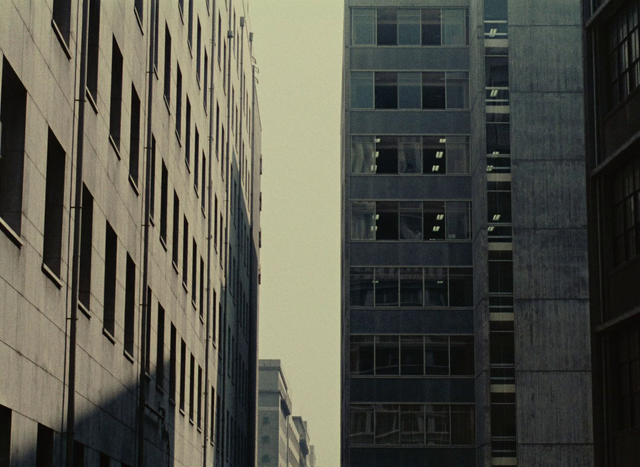
On one side of this everyday life exists office space, the stronghold of the salaryman. Ozu’s office scenes in the new salaryman films visualise one of the most tasteless and expressionless spaces he ever created. And he repeats almost the same mise en scène for this again and again throughout the period as if to confirm the banal nature of the space. The rigid colour palette is dominated by monotonous blues and greys, and seamlessly blended profile shots of a working salaryman father are repeatedly shown, whilst the sounds of noisy machinery or traffic are heard from outside. Typically, an acquaintance will walk down a long corridor to visit the salaryman in the office. And throughout such a scene the camera never moves an inch. Ozu, however, hardly permits the salaryman characters a reflection upon the meaning of this monotonous repetitiveness; for most of the time, they and their visitors talk about marriage and the opportunity of an omiai.
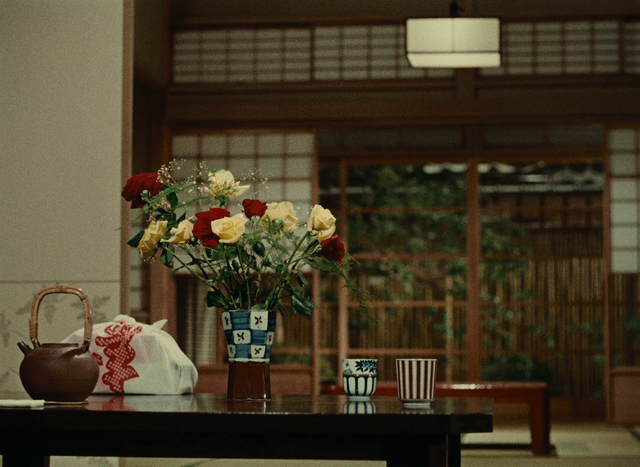
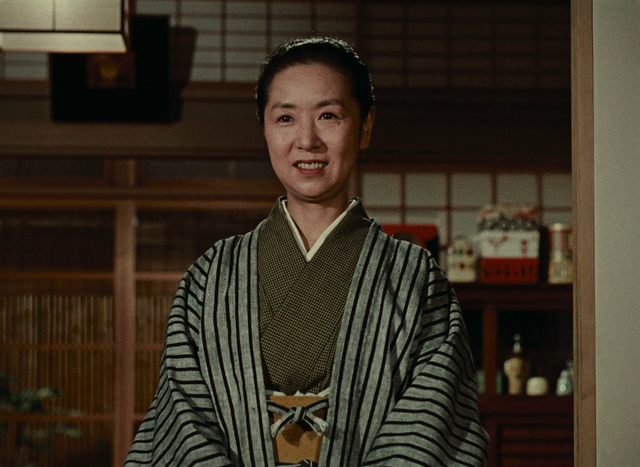
What lies on the other side of this everyday life is domesticity. Ozu always excelled at depicting the domestic environment, but those of the new salaryman films are distinct for their more stable and affluent atmosphere. An important space that contributes to this change is the living room (chanoma) as a place for family gathering. It is not that Ozu had not deployed the space before. However, the chanoma in Ozu’s previous films was used more as a specific ‘meeting’ place to have a meal, welcome a guest or talk about a serious familial issue such as marriage. Individual space accordingly received more attention, such as Noriko’s upstairs room in Late Spring. This characteristic changes in the new salaryman films; the chanoma finally obtains its full function as an everyday space where family members encounter each other ‘without a specific purpose’ except relaxation – to talk, read or snack – creating a conventional middle-class domestic landscape.The one who controls this space and time is not the patriarch but the housewife/mother, who, even while appearing subservient to her husband, adroitly mediates communication between the blunt father and the resistant child in order to maintain familial harmony. Ozu also strengthens this domestic stability with his static camera, which concentrates extensively on layered spatial structures and various domestic objects. Again, this is far from a novel experiment for the director, but in the new salaryman films, his virtuosity reaches the point of utmost visual pleasure. It would not be necessary to reconfirm the fact here that critics have already made on this formal refinement, except for the point that the use of colour, which Ozu began to employ from Equinox Flower in 1958 on, greatly contributed to the emphasis on domestic space and objects, which is effectively contrasted with the dullness of the office spaces mentioned earlier. (Woojeong Joo)

[ About file ]
Name: Equinox Flower.Yasujirô Ozu.1958.BluRay.Slope.mkv
Date: Fri, 06 Nov 2026 22:43:15 +0100
Size: 20,803,647,746 bytes (19839.904543 MiB)
[ Magic ]
File type: Matroska data
File type: EBML file, creator matroska
[ Generic infos ]
Duration: 01:57:53 (7072.835 s)
Container: matroska
Production date: Thu, 29 Oct 2026 11:26:21 +0100
Total tracks: 9
Track nr. 1: video (V_MPEG4/ISO/AVC) {und}
Track nr. 2: audio (A_FLAC) {jpn}
Track nr. 3: subtitle (S_TEXT/UTF8) [American] {eng}
Track nr. 4: subtitle (S_TEXT/UTF8) [British] {eng}
Track nr. 5: subtitle (S_TEXT/UTF8) [Castilian] {spa}
Track nr. 6: subtitle (S_TEXT/UTF8) [French] {fre}
Track nr. 7: subtitle (S_TEXT/UTF8) [Italian] {ita}
Track nr. 8: subtitle (S_HDMV/PGS) [Japanese PGS] {jpn}
Track nr. 9: subtitle (S_TEXT/UTF8) [Chinese Simplified] {chi}
Muxing library: libebml v1.4.7 + libmatroska v1.7.2 + muxtools v0.5.0b1
Writing application: mkvmerge v102.0 ('Little Houses') 64-bit
[ Relevant data ]
Resolution: 1480 x 1080
Width: multiple of 8
Height: multiple of 8
Average DRF: 19.584162
Standard deviation: 2.862151
Std. dev. weighted mean: 2.729541
[ Video track ]
Codec ID: V_MPEG4/ISO/AVC
Resolution: 1480 x 1080
Frame aspect ratio: 37:27 = 1.37037
Pixel aspect ratio: 1:1 = 1
Display aspect ratio: 37:27 = 1.37037
Framerate: 23.976024 fps
Stream size: 20,545,756,792 bytes (19593.960564 MiB)
Duration (bs): 01:57:53 (7072.815693 s)
Bitrate (bs): 23239.125895 kbps
Qf: 0.606397
[ Audio track ]
Codec ID: A_FLAC
Sampling frequency: 48000 Hz
Channels: 1
Sample size: 16-bit
[ Video bitstream ]
Bitstream type: MPEG-4 Part 10
User data: x264 | core 165 r3223 0480cb0 | H.264/MPEG-4 AVC codec
User data: Copyleft 2003-2025 | http://www.videolan.org/x264.html | cabac=1
User data: ref=5 | deblock=1:-3:-3 | analyse=0x3:0x133 | me=umh | subme=11
User data: psy=1 | psy_rd=1.06:0.00 | mixed_ref=1 | me_range=32 | chroma_me=1
User data: trellis=2 | 8x8dct=1 | cqm=0 | deadzone=21,11 | fast_pskip=1
User data: chroma_qp_offset=-2 | threads=24 | lookahead_threads=4
User data: sliced_threads=0 | nr=0 | decimate=0 | interlaced=0
User data: bluray_compat=0 | constrained_intra=0 | bframes=8 | b_pyramid=2
User data: b_adapt=2 | b_bias=0 | direct=3 | weightb=1 | open_gop=0 | weightp=2
User data: keyint=250 | keyint_min=23 | scenecut=40 | intra_refresh=0 | rc=crf
User data: mbtree=0 | crf=18.1 | qcomp=0.62 | qpmin=0 | qpmax=69 | qpstep=4
User data: ip_ratio=1.40 | pb_ratio=1.32 | aq=3:0.83
SPS id: 0
Profile: High@L4.1
Num ref frames: 5
Aspect ratio: Square pixels
Chroma format: YUV 4:2:0
PPS id: 0 (SPS: 0)
Entropy coding type: CABAC
Weighted prediction: P slices - explicit weighted prediction
Weighted bipred idc: B slices - implicit weighted prediction
8x8dct: Yes
Total frames: 169,578
Drop/delay frames: 0
Corrupt frames: 0
P-slices: 31489 ( 18.569 %) ####
B-slices: 136900 ( 80.730 %) ################
I-slices: 1189 ( 0.701 %)
SP-slices: 0 ( 0.000 %)
SI-slices: 0 ( 0.000 %)
[ DRF analysis ]
average DRF: 19.584162
standard deviation: 2.862151
max DRF: 30
DRF<7: 0 ( 0.000 %)
DRF=7: 1 ( 0.001 %)
DRF=8: 0 ( 0.000 %)
DRF=9: 1 ( 0.001 %)
DRF=10: 23 ( 0.014 %)
DRF=11: 45 ( 0.027 %)
DRF=12: 147 ( 0.087 %)
DRF=13: 1140 ( 0.672 %)
DRF=14: 3251 ( 1.917 %)
DRF=15: 6235 ( 3.677 %) #
DRF=16: 11979 ( 7.064 %) #
DRF=17: 16958 ( 10.000 %) ##
DRF=18: 19418 ( 11.451 %) ##
DRF=19: 22804 ( 13.447 %) ###
DRF=20: 29451 ( 17.367 %) ###
DRF=21: 24567 ( 14.487 %) ###
DRF=22: 13775 ( 8.123 %) ##
DRF=23: 5394 ( 3.181 %) #
DRF=24: 3267 ( 1.927 %)
DRF=25: 4295 ( 2.533 %) #
DRF=26: 3709 ( 2.187 %)
DRF=27: 1052 ( 0.620 %)
DRF=28: 646 ( 0.381 %)
DRF=29: 1419 ( 0.837 %)
DRF=30: 1 ( 0.001 %)
DRF>30: 0 ( 0.000 %)
P-slices average DRF: 17.885611
P-slices std. deviation: 2.676487
P-slices max DRF: 27
B-slices average DRF: 20.001161
B-slices std. deviation: 2.743773
B-slices max DRF: 30
I-slices average DRF: 16.555088
I-slices std. deviation: 2.496026
I-slices max DRF: 26
[ Edition entry ]
UID: 6598805445729498651
Hidden: No
Selected by default: Yes
Playlist: No
Chapters:
00:00:00,000-00:02:51,755: Opening Credits {eng}
00:02:51,755-00:10:54,237: Wedding Day {eng}
00:10:54,237-00:15:32,390: Family Life {eng}
00:15:32,390-00:22:52,913: Day at the Office {eng}
00:22:52,913-00:28:14,026: Yukiko {eng}
00:28:14,026-00:31:41,650: Marriage Talk {eng}
00:31:41,650-00:37:00,468: Prospects {eng}
00:37:00,468-00:41:02,585: Together {eng}
00:41:02,585-00:44:37,592: Taniguchi Asks Permission {eng}
00:44:37,592-00:47:07,283: Disapproval {eng}
00:47:07,283-00:55:28,492: Yes or No? {eng}
00:55:28,492-01:02:50,308: Bar Luna {eng}
01:02:50,308-01:06:24,731: Fumiko's Happiness {eng}
01:06:24,731-01:09:03,348: Sleepless {eng}
01:09:03,348-01:12:32,390: Hirayama Delivers a Message {eng}
01:12:32,390-01:19:24,260: Yukiko's Trick {eng}
01:19:24,260-01:26:37,484: Kiyoko Speaks Her Mind {eng}
01:26:37,484-01:29:40,250: The Go-between {eng}
01:29:40,250-01:37:43,316: A Change of Mind {eng}
01:37:43,316-01:45:28,280: Alumni Reunion {eng}
01:45:28,280-01:51:35,189: Brass Into Gold {eng}
01:51:35,189-01:57:52,189: Hiroshima {eng}
This report was created by AVInaptic (01-11-2020) on 10-11-2026 21:58:41