Hitler: The Last Ten Days 1955 DEU SUB ENG DVDRip x264
INFO HASH: 496E9BAFD7175DD45C360BF70EA329E00632E24E

Year: 1955
Country: West Germany, Austria
Director: Georg Wilhelm Pabst
Cast: Albin Skoda, Oskar Werner, Lotte Tobisch, Willy Krause
IMDB: Link
Language : German
Subtitles : English

The mediocrity of Pabst's postwar work might be explained by the low quality of German film production in general, but, in fact, his excursions to America and Italy were evasive diversions from a subject he had been preoccupied with since the end of the war: a film about Hitler. Hitler had already been impersonated in many dramatic films by such actors as Ludwig Donath (The Strange Death of Adolf Hitler, 1943), Robert Watson (The Hitler Gang, 1944), Luther Adler {The Magic Face, 1951), and in satiric style by Chaplin in The Great Dictator. In German film, however, a trend was formulated—exemplified by Alfred Weidemann's popular Admiral Canaris—that camouflaged guilt complexes by accusing Hitler of everything and trying to prove that all Germans were not Nazi.
Pabst was determined that his image would be unsparing in its truthfulness and that it would capture the atmosphere of collective paranoia that found its central focus in the dementia of the Fiihrer himself whose insidious thinking spawned a nationalist conspiracy. He ultimately found a treatment that appealed to him in Erich Maria Remarque's scenario, taken from the journal of Michael A. Musmano of the International Tribunal at Nuremberg, Ten Days to Die. The final script, written by Fritz Habeck, remains close to documentation with only a few additions for dramatic purposes.
Pabst proceeded to cast the film with extreme care, choosing actors who not only closely physically resembled their real counter parts but who were also skilled actors. Hitler's bunker was copletely reconstructed according to its original size and layout on the sound stage. Pabst was determined to realign himself, aesthetically, with his former "realist" tendencies, with an unadorned vision of a claustrophobic environment.
Known in Britain as Ten Days to Die and in the U.S. The Last Ten Days, Der Letzte Akt unravels the events that reportedly occured in and around the Chancellery in Berlin during the last days of the Fiihrer's reign of terror. For the most part, Pabst remains in this closely guarded arena, studying the deterioration of Hitler, psychologically and physically, as a metaphor for the impending collapse of an entire nation. The most significant concession to ficttion is the figure of Wurst, a young captain, splendidly portrayed by Oskar Werner, who gradually comes to represent the spirit of humanistic conscience tragically caught in a web of insanity. Functioning as a chorus of one, he is the first and last person to appear on screen. Initially, he is carrying out orders to accompany an officer on a special mission. When the officer is killed, he hopes to take his place and reports to the Fiihrer himself but his request is consitently turned down.
Unaware that Wurst has arrived with news from the Eastern front. Hitler continues to argue with his generals over mifitary strategy, refusing to consider the situation rationally. Like a medieval monarch he consults his astrologer, who naturally forecasts victory. When his closest advisors salute him on his birthday, then advise him that he is no longer safe in Berlin, Hitler responds with a defensive rage and personally assumes total control of his military machine. The staunch idealism of his youngest soldiers is evidenced in a brief, perfectly realized scene in which the Fiihrer decorates a group of teen-age boys for bravery and smilingly stuffs them with cake and coffee, while from a beer hall replete with Pabstian "atmosphere" men are called from drinking and singing to defend the city.
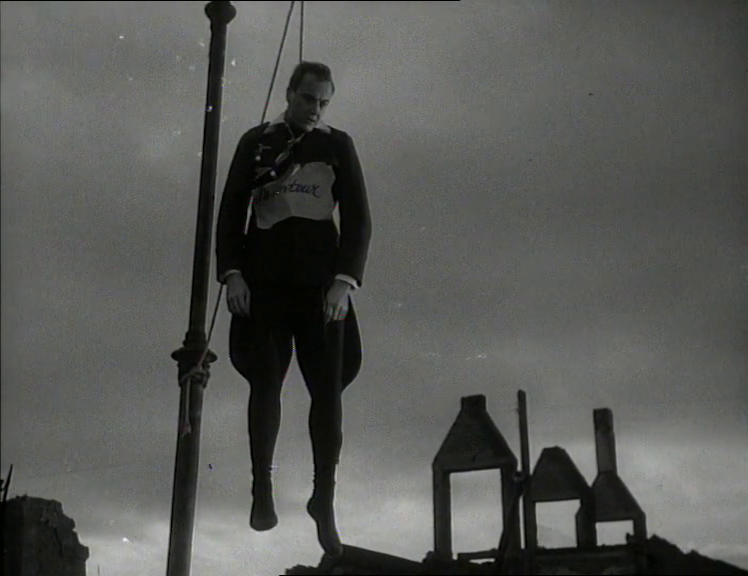
In addition to the fictional introduction of Captain Wurst, Pabst follows briefly the peregrinations of a young soldier on leave to visit his family. These scenes not only provide relief from the highly charged atmosphere of Hitlerìs Chancellery but also comment on the sinking morale and deflated illusions of the average German. The boy is traumatized by the suicide of a defeated major who hangs himself from a lamppost, and while searching for his bedridden mother, the youth ends up in a subway station that has been temporarily coverted into a hospital for the scores of wounded.
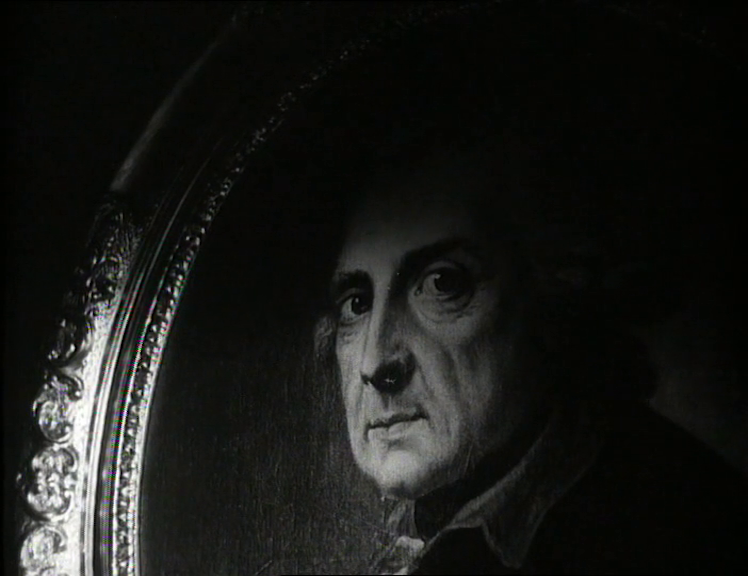
Having established the various themes and subjects, Pabst proceeds to develop them through alternating contrast until they reach a climax in the fonale. Wurst ultimately succeeds in gaining an audience with Hitler to reveal the failing German position at the front, but the leader willfully consolidates his forces against the Americans and Russians. While Wurst drowns his fears in a beer hall. Hitler retreats to his private sanctuary where he momentarily contemplates suicide. Then, overwhelmed by a moment of transcendent visionary madness, he sees the earth as a filthy swamp filled with "shmy beasts," and yearns for a single weapon with which he might obliterate everything, calling on the spirit of his predecessor, Frederick the Great.
The dramatic climax is provided by the invasion of Berlin and Kilterìs decision to flood the subway tunnels under Friedrichstrasse to slow the Allied assault on the city. Now the German leader resembles a mere husk of a man, hounded by fear and heedless of the wounded in the underground ("What is another thousand or more now?"). While the boy whose mother is endangered begs Wurst to intercede, Pabst intercuts a brief scene in which two
officers privately voice their fears of what will happen to them when "all this" is over. The beginning of the end is announced as Wurst confronts the solitary and terror-stricken Fiihrer in his private quarters with the monstrosity of his act and the quiet affirmation that "a man shouldn't always obey orders." Cornering his leader in a stranglehold, Wurst is fatally wounded by guards.
Pabst plays off the anxiety-ridden atmosphere of the bunker against the flooding of the subway with great virtuosity and power in composition and editing tempo. While Hitler and Eva Braun are married in a brief, solemn ceremony, and Wurst is slowly dying in the arms of a young soldier, in the smoke-filled beer cellar men and women dance and drink themselves into oblivion and erotic embrace as hundreds of victims are trapped by the onrush of water in the underground tunnels. Following the death of Hitler and his bride—aurally indicated by off-screen gunfire heard by the staff in an ajoining room—Pabst cuts to a long silent tracking through the water-logged tunnel revealing no signs of life. The bodies of Hitler and Eva Braun are incinerated in a shallow ditch, and overlapping with a shot of the flames is a close-up of the expiring Wurst whose last words summon the Hitlerian youth to surrender: "Always keep the faith, never say Jawohl, that's how it all began."
Wurst's final words, implicating everyone in Hitler's conspiracy, not just his bloodthirsty henchmen and cowardly assistants, but everyone who saluted the cause, failed to win the approval of German audiences and critics, though opinion elsewhere was unanimously positive; and Pabst's last masterpiece graced the Locarno and Edinburg festivals where it acquired an international distribution, the first in many years for a Fabst film.
Pabst's dramatic and imaginative portrayal of this tragic episode in German history derives its efficacy to a large degree not from fidelity to historical fact but from its poetic and psychological intensity rendered through fluuid cinematic techniques. By lighting and shooting from low angles, often exposing the very low ceilings of the sets, Pabst accentuates the claustrophobic atmosphere of the bunker, and the constant play of light and shadow becomes increasingly menacing as the action draws to its climactic stages. Flexible settings allow the camera an expressive mobility and while the textures of the photography are relatively free from Pabst's early Expressionist embellishments, the scenes in the beer halls and the flooded subway naturally bear a resemblence to moments in Pandora's Box and Kameradschaft.
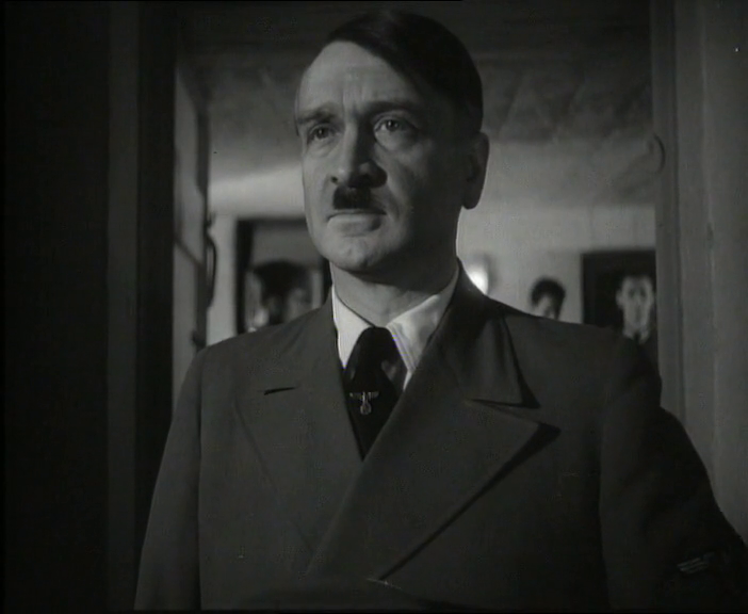
The direction of the actors is uniformly inspired. All other impersonations of Hitler—including succeeding ones by Richard Basehart and Alec Guinness—remain caricatures beside the veracity of Albin Skoda's, for which he achieved fame. Not only does a skilled makeup transform him into a close match for Hitler, but his uncanny ability to duplicate his vocal and physical mannerisms and modulate emotional ranges from paternal affection to sudden rage to boiling fury are conveyed with astonishing finesse and power, without falling into melodramatic cliche. Equally distinguished in this respect are Willy Krauss's Goebbels and Eric Suckmann's Heinrich
Himmler.
Pabst gives special attention, however, to Oskar Wernerìs character. Although it might be argued that the film's thesis could have been conveyed equally well without him and that fictional license robs his role of authenticity, nevertheless, he embodies the sentiments of a director who needed a surrogate figure to represent his own conscience in a final effort to clear himsellf. At the same time, Albin Skodaìs portrait of Hitler can be seen as a successor to Werner Krauss's Dr. Caligari, confirming the psychological evolution traced in German cinema by Siegfried Kracauer {From Caligari to Hitler). (Lee Atwell)

[ About file ]
Name: Hitler -The Last Ten Days.Georg Wilhelm Pabst.1955.DVDRip.mkv
Date: Fri, 04 Sep 2026 00:44:55 +0200
Size: 1,675,628,759 bytes (1598.004111 MiB)
[ Magic ]
File type: Matroska data
File type: EBML file, creator matroska
[ Generic infos ]
Duration: 01:47:00 (6420.28 s)
Container: matroska
Total tracks: 2
Track nr. 1: video (V_MPEG4/ISO/AVC) {eng}
Track nr. 2: audio (A_AC3) {deu}
Writing application: HandBrake 0.9.4
[ Relevant data ]
Resolution: 702 x 576
Width: multiple of 2
Height: multiple of 32
Average DRF: 24.985103
Standard deviation: 0.210874
Std. dev. weighted mean: 0.000914
[ Video track ]
Codec ID: V_MPEG4/ISO/AVC
Resolution: 702 x 576
Display resolution: 748 x 576 (pixels)
Frame aspect ratio: 39:32 = 1.21875
Pixel aspect ratio: 374:351 = 1.065527
Display aspect ratio: 187:144 = 1.298611
Framerate: 25 fps
Stream size: 1,517,332,867 bytes (1447.041385 MiB)
Duration (bs): 01:47:00 (6420.28 s)
Bitrate (bs): 1890.675007 kbps
Qf: 0.187033
[ Audio track ]
Codec ID: A_AC3
Sampling frequency: 48000 Hz
Channels: 2
Stream size: 154,089,216 bytes (146.950928 MiB)
Bitstream type (bs): AC3
Frames (bs): 200,637
Duration (bs): 01:47:00 (6420.384 s)
Chunk-aligned (bs): Yes
Bitrate (bs): 192 kbps CBR
Sampling frequency (bs): 48000 Hz
Mode (bs): stereo
[ Video bitstream ]
Bitstream type: MPEG-4 Part 10
User data: x264 | core 79 | H.264/MPEG-4 AVC codec | Copyleft 2003-2009
User data: http://www.videolan.org/x264.html | cabac=1 | ref=9 | deblock=1:0:0
User data: analyse=0x3:0x113 | me=umh | subme=7 | psy=1 | psy_rd=1.0:0.0
User data: mixed_ref=1 | me_range=16 | chroma_me=1 | trellis=1 | 8x8dct=1
User data: cqm=0 | deadzone=21,11 | chroma_qp_offset=-2 | threads=6 | nr=0
User data: decimate=1 | mbaff=0 | constrained_intra=0 | bframes=12
User data: b_pyramid=0 | b_adapt=2 | b_bias=0 | direct=1 | wpredb=1 | wpredp=2
User data: keyint=250 | keyint_min=25 | scenecut=40 | rc_lookahead=50 | rc=crf
User data: mbtree=1 | crf=19.8 | qcomp=0.60 | qpmin=10 | qpmax=51 | qpstep=4
User data: ip_ratio=1.40 | aq=1:1.00
SPS id: 0
Profile: High@L3.1
Num ref frames: 9
Aspect ratio: Custom pixel shape (16:15 = 1.066667)
Chroma format: YUV 4:2:0
PPS id: 0 (SPS: 0)
Entropy coding type: CABAC
Weighted prediction: P slices - explicit weighted prediction
Weighted bipred idc: B slices - implicit weighted prediction
8x8dct: Yes
Total frames: 160,507
Drop/delay frames: 0
Corrupt frames: 0
P-slices: 43646 ( 27.193 %) #####
B-slices: 116061 ( 72.309 %) ##############
I-slices: 800 ( 0.498 %)
SP-slices: 0 ( 0.000 %)
SI-slices: 0 ( 0.000 %)
[ DRF analysis ]
average DRF: 24.985103
standard deviation: 0.210874
max DRF: 25
DRF<22: 0 ( 0.000 %)
DRF=22: 797 ( 0.497 %)
DRF=23: 0 ( 0.000 %)
DRF=24: 0 ( 0.000 %)
DRF=25: 159710 ( 99.503 %) ####################
DRF>25: 0 ( 0.000 %)
P-slices average DRF: 25
P-slices std. deviation: 0
P-slices max DRF: 25
B-slices average DRF: 25
B-slices std. deviation: 0
B-slices max DRF: 25
I-slices average DRF: 22.01125
I-slices std. deviation: 0.183367
I-slices max DRF: 25
[ Edition entry ]
UID: 165706417
Hidden: No
Selected by default: Yes
Playlist: No
Chapters:
00:00:00,000-00:10:59,520: Chapter 1 {eng}
00:10:59,520-00:19:47,040: Chapter 2 {eng}
00:19:47,040-00:28:42,240: Chapter 3 {eng}
00:28:42,240-00:38:24,960: Chapter 4 {eng}
00:38:24,960-00:48:22,560: Chapter 5 {eng}
00:48:22,560-00:59:33,120: Chapter 6 {eng}
00:59:33,120-01:08:41,280: Chapter 7 {eng}
01:08:41,280-01:17:12,960: Chapter 8 {eng}
01:17:12,960-01:24:31,680: Chapter 9 {eng}
01:24:31,680-01:33:13,920: Chapter 10 {eng}
01:33:13,920-01:40:28,320: Chapter 11 {eng}
01:40:28,320-01:46:58,360: Chapter 12 {eng}
01:46:58,360-01:47:00,280: Chapter 13 {eng}
This report was created by AVInaptic (01-11-2020) on 12-10-2026 02:46:09