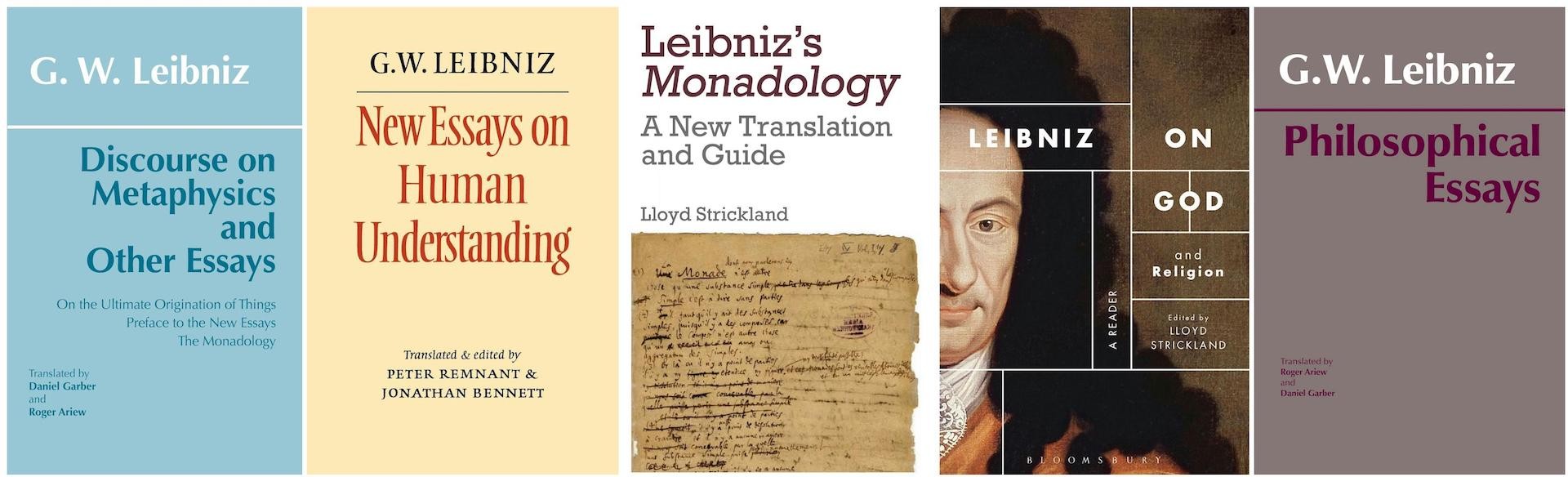
Gottfried Wilhelm Leibniz - Collected Philosophical Works (38 books)
INFO HASH: ADE21330CC171B68779D991506A1BFBFECCE2DB8

* Gottfried Wilhelm Leibniz - Collected Philosophical Works (38 books)
GOTTFRIED WILHELM LEIBNIZ (1646–1716) was a German polymath whose work spanned numerous fields, including philosophy, mathematics, logic, theology, law, and diplomacy. He is credited, alongside Isaac Newton, with the creation of calculus in addition to many other branches of mathematics, such as binary arithmetic and symbolic logic. Yet he regarded himself primarily as a philosopher. His thought aimed at a grand synthesis: reconciling the new mechanistic science with traditional metaphysics and Christian theology, and demonstrating that reason could reveal a harmonious, rational structure underlying reality.
Many of Leibniz’s central metaphysical ideas appear in relatively short works written for specific correspondents. THE DISCOURSE ON METAPHYSICS (written 1686) lays out key doctrines such as the complete concept of an individual substance and the harmony between divine providence and created freedom. His mature system receives its most compressed and famous expression in the MONADOLOGY (1720), which presents reality as composed of simple, immaterial “monads” coordinated through a pre-established harmony. Closely related is the PRINCIPLES OF NATURE AND GRACE BASED ON REASON (1718), which offers a parallel, slightly more accessible summary of his metaphysics and natural theology.
Leibniz’s only major philosophical book published during his lifetime was the THEODICY (1710), a sustained response to the problem of evil in which he argues that this world is the best of all possible worlds consistent with divine wisdom and goodness. His epistemology and philosophy of mind are developed at length in the NEW ESSAYS ON HUMAN UNDERSTANDING (published posthumously in 1765), a dialogue engaging critically with the empiricism of John Locke. An earlier and often overlooked work, the CONFESSIO PHILOSOPHI (first published 1840), reveals the formative stages of his thought on necessity, freedom, and divine foreknowledge.
As a mathematician, his major achievement was the development of differential and integral calculus, independently of Newton's contemporaneous developments. Leibniz's notation has been favored as the conventional and more exact expression of calculus. In addition, he is credited with devising the modern binary number system, anticipating a universal language of reasoning centuries before modern developments in communications and digital computing.
Equally important are Leibniz’s extensive correspondences , through which many of his ideas were first articulated and refined. His exchanges with Antoine Arnauld (1686–1690) probe the nature of substance and contingency; his letters to Samuel Clarke (1715–1716) debate space, time, and divine action in response to Newtonian physics; and his long correspondence with Sophie Charlotte helped shape the popular presentation of his philosophy. Because much of Leibniz’s writing remained unpublished in his lifetime and circulated in letters and manuscripts, his philosophical legacy is dispersed across essays, drafts, and correspondence—together forming one of the most ambitious and systematic bodies of thought in the early modern period that has left a lasting mark on both philosophy and the emerging sciences.
The following books are in PDF unless otherwise noted:
* A Unitary Principle of Optics, Catooptrics, and Dioptrics (2004)
* The Art of Controversies [tr. Dascal] (Springer, 2006)
* Collected Works (Delphi Classics, 2025) – ePUB
* Confessio Philosophi [tr. Sleigh] (Yale, 2005)
* De Summa Rerum: Metaphysical Papers [tr. Parkinson] (Yale, 1992)
* Discourse on Metaphysics [tr. Johns] (Edinburgh, 2023) – ePUB/PDF
* Discourse on Metaphysics [tr. Montgomery & Chandler] (Anchor, 1990) – ePUB
* Discourse on Metaphysics [tr. Rodriguez-Pereyra] (Oxford, 2020)
* Discourse on Metaphysics & Other Essays [tr. Garber & Ariew] (Hackett, 1991)
* Discourse on Metaphysics & Related Writings [tr. Martin & Brown] (Manchester, 1988)
* Dissertation on Combinatorial Art [tr. Mugnai] (Oxford, 2000) – ePUB / PDF
* Dissertation on Predestination and Grace [tr. Murray] (Yale, 2011)
* Early Mathematical Manuscripts [tr. Child] (Dover, 2005) – ePUB
* General Inquiries on the Analysis of Notions and Truths [ed. Mugnai] (Oxford, 2021) – ePUB / PDF
* Journal Articles in Philosophy [ed. Lodge] (Oxford, 2025) – ePUB / PDF
* Labyrinth of the Continuum [tr. Arthur] (Yale, 2001)
* Leibniz on God and Religion: A Reader [ed. Strickland] (Bloomsbury, 2016)
* Leibniz on the Parallel Postulate and the Foundations of Geometry (Birkhäuser, 2016)
* Leibniz-Stahl Controversy [tr. Duchesneau & Smith] (Yale, 2016)
* Logical Papers [tr. Parkinson] (Oxford, 1966)
* Monadology [tr. Strickland] (Edinburgh, 2014) – ePUB / PDF
* Monadology [tr. Rescher] (Pittsburgh, 1991)
* New Essays on Human Understanding [tr. Remnant & Bennett] (Cambridge, 1981)
* Philosophical Essays [tr. Ariew & Garber] (Hackett, 1989) – ePUB/PDF
* Philosophical Papers and Letters [tr. Loemker, 2e] (Kluwer, 1989)
* Philosophical Texts [tr. Woolhouse & Francks] (Oxford, 1998)
* Philosophical Writings [ed. Parkinson] (Dent, 1973)
* Political Writings [ed. Riley, 2e] (Cambridge, 1988)
* Protogaea [tr. Cohen & Wakefield] (Chicago, 2008)
* The Shorter Leibniz Texts [ed. Strickland] (Continuum, 2006)
* Theodicy [ed. Farrer] (Open Court, 1985)
* Writings on China [tr. Cook & Rosemont] (Open Court, 1994)
== LETTERS ==
* Leibniz and the Two Sophies [ed. Strickland] (CRRS, 2011)
* Leibniz–Arnauld Correspondence [tr. Mason] (Manchester, 1967)
* Leibniz–Caroline Clarke Correspondence [tr. Brown] (Oxford, 2023)
* Leibniz–Des Bosses Correspondence [tr. Look & Rutherford] (Yale, 2007)
* Leibniz–Samuel Clarke Correspondence [ed. Ariew] (Hackett, 2000)
* Leibniz’s Correspondence in Science, Technology and Medicine, 1676-1701 [tr. O'Hara] (Brill, 2024)
Please seed and share with others. ?